
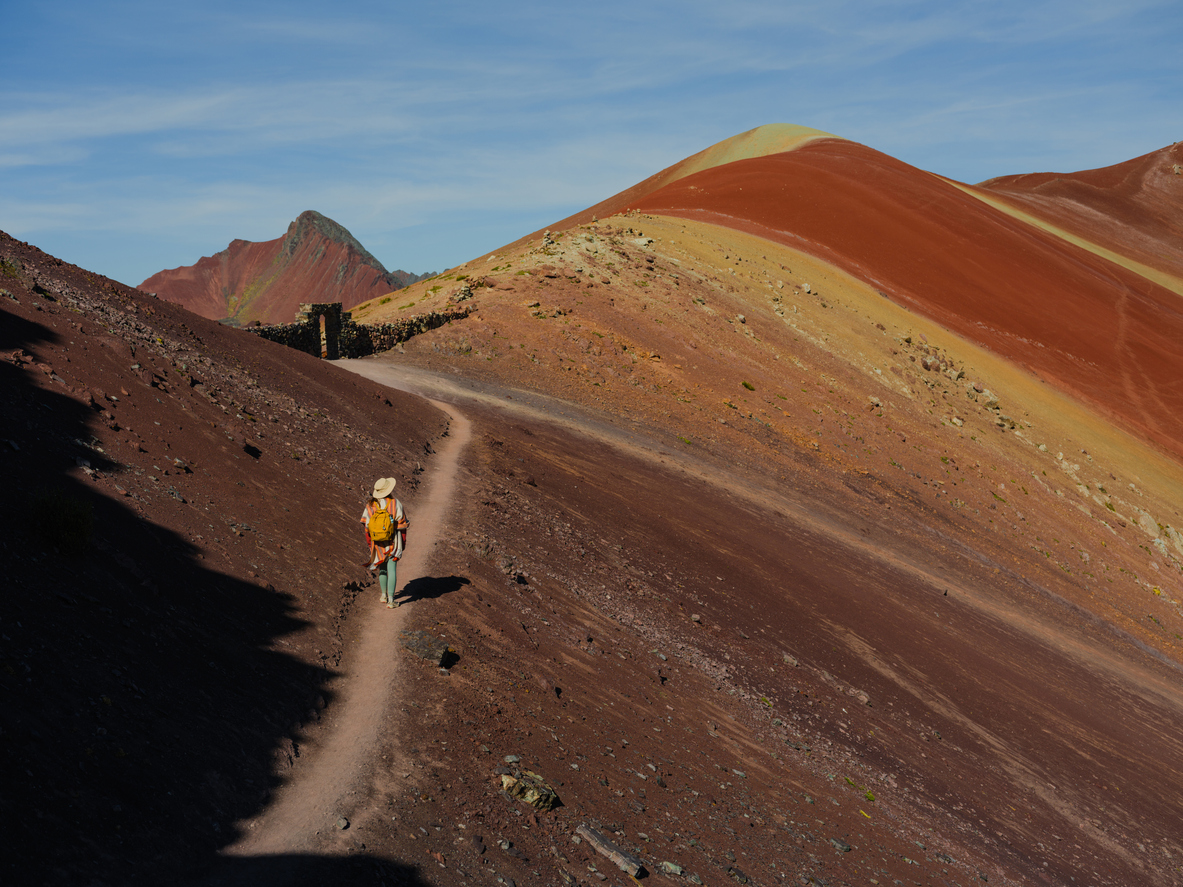
Why is rainbow mountain colorful? Mostly because of one metal, in two different states, and a glacier that is no longer there.
It is not paint. It is not a filter, though the photographs you have seen were probably pushed a long way in editing. And until roughly ten years ago you could not have seen it at all. The stripes were under permanent ice.
We take people to both rainbow mountains, Vinicunca and Palccoyo, most weeks of the year. This is the explanation our guides give on the walk up, written down properly.

The short answer
The stripes are layers of sedimentary rock. Each layer settled flat on the bed of a river, a lake or a shallow sea. That took tens of millions of years. Each one carried a slightly different mix of minerals.
Then the Andes rose. The uplift folded the layers and tipped them to a steep angle. Think of a stack of coloured paper pushed over on its side.
Then ice and weather stripped the surface off, and the iron in the exposed rock reacted with air and water. Where the iron rusted, the rock went red. Where it did not, the rock stayed green. Everything else is a variation on those two.
Colour by colour
Why one metal makes both the red and the green
This is the part worth understanding, because it explains the whole mountain and most other coloured rock on earth.
Iron atoms can exist in two common states. In one, each atom has given up two electrons. Chemists call this ferrous iron. In the other, it has given up three. That is ferric iron. The difference is a single electron, and it changes the colour completely.
Ferric iron is what you get when iron meets oxygen and water. It is rust. Its minerals, hematite and goethite, are red, orange and brown. Any rock with enough ferric iron in it is red. That is why deserts, bricks, Mars and Rainbow Mountain share a palette.
Ferrous iron is what you get when oxygen is scarce. It sits in minerals like chlorite, and those minerals are green. Rock that formed in stagnant water, or that was buried before air reached it, keeps its iron in this state.
So the red bands and the green bands are not different ingredients. They are the same ingredient with a different history. One layer formed or weathered where oxygen was plentiful. The next formed where it was not. The stripe pattern is a record of changing conditions, written in electrons.
The yellow is the halfway house. Limonite is iron oxide with water bound into it, and it sits between the rust red and the pale sandstone.
The white is simply the absence of iron. Quartz sand and lime with nothing to colour them.

How flat layers ended up standing on edge
Every one of those layers was horizontal when it formed. Sediment settles flat. The stripes you see running diagonally across the ridge are the same beds, tilted.
The tilting is the Andes. The Nazca plate, under the Pacific, has been sliding beneath the South American plate for tens of millions of years. The collision crumples the continent’s edge upward. It folded, faulted and shoved up the sedimentary cover that once lay flat across the region. At Vinicunca the fold left the beds standing at a steep angle. Erosion later cut across them and exposed each one as a stripe.
That is also why the stripes are so regular. They are not paint on a surface. They run straight through the mountain, and if you could cut it in half the pattern would continue inside.
The glacier that hid it
Until about a decade ago Vinicunca was not a rainbow. It was a snow slope.
The colours were there, under permanent ice and snow. That cover had sat on the ridge for as long as anyone could remember. The ice retreated through the early 2010s as temperatures in the high Andes rose. The stripes emerged. By 2015 or 2016 the first tour buses were arriving from Cusco. Within a couple of years it was the second most visited site in the region after Machu Picchu. [CONFIRM: the year your own company first ran it.]
There is no comfortable way to say this. The most photographed new landscape in Peru exists because the climate warmed enough to melt what covered it. The same warming is shrinking the Quelccaya ice cap, the largest tropical ice mass on earth, forty kilometres away.
We tell people this on the walk. Most had not thought about it, and most are glad to know.

Why it never looks like the photographs
The colours in the rock are real. The colours on Instagram are usually not.
Three things separate what you see from what you have seen online.
Saturation. Nearly every popular image of Rainbow Mountain has had its colour pushed hard in editing. The real red is a deep earthy red, not scarlet. The real green is olive rather than emerald. Both are unmistakable and both are more muted than the phone screen version.
Light. Flat midday sun bleaches the stripes. Low morning light, or the minutes after a cloud passes, brings them up. Our Vinicunca departures leave Cusco early partly for the altitude and partly for the light.
Water. Wet rock is darker and more saturated than dry rock. A wet pebble looks better than a dry one for the same reason. A shower that clears is the best thing that can happen to the view. Persistent cloud and snow are the worst, because they hide the stripes entirely. Our honest guide to whether Rainbow Mountain is worth it covers the reliable window and the months to avoid.
The same rock, twenty kilometres away
The layers at Vinicunca do not stop at Vinicunca. The same sequence of red, green and yellow beds runs through the whole Ausangate region, and it surfaces again at Palccoyo, where erosion has cut it into three separate striped ridges rather than one.
Which means the geology is identical and the experience is not. Vinicunca is one great striped face at 5,036 metres after a ninety minute climb. Palccoyo is three smaller ones at around 4,900 metres after a walk of under an hour. Our comparison of the two sets out which suits whom. The rock does not care which you choose.

Frequently asked questions
Why is Rainbow Mountain colourful?
Its stripes are layers of sedimentary rock carrying different minerals. Iron oxide makes the reds and pinks, chlorite and other unoxidised iron minerals make the green, limonite and sulphur minerals make the yellow, and calcium carbonate makes the white. Andean uplift tilted the layers on edge and retreating ice exposed them.
Are the colours of Rainbow Mountain real?
Yes, though most photographs exaggerate them. The real reds are earthy rather than scarlet and the greens are olive rather than emerald. The stripes are genuinely there, run right through the mountain, and look best in low light or after rain.
Was Rainbow Mountain always visible?
No. The striped ridge was under permanent snow and ice until the early 2010s. Glacier retreat exposed it, and tourism began around 2015.
Is Rainbow Mountain painted?
No. The colours are minerals in the rock itself. If the mountain were cut in half the stripes would continue through the inside.
Does Palccoyo have the same colours as Vinicunca?
Yes. Both sit in the same sequence of sedimentary layers in the Ausangate region. Palccoyo shows them across three ridges rather than one, at a lower altitude and after a shorter walk.
The colours are one reason to go. Before you do, read what the climb to 5,036 metres actually demands.