

The Uros islands sit on Lake Titicaca, a short boat ride from Puno. People live on them. The islands themselves are made of reeds and they float.
Two questions follow, and most articles answer only the first.
How does that work? And is any of it real, or is it a performance put on for the boats that arrive every morning?
Both deserve a straight answer.

How you build an island out of grass
Totora is a reed that grows in the shallows of Titicaca. It is the whole material.
Start with the root mass. Totora grows from dense blocks of root and soil that float on their own once cut free. Islanders cut these into rough rectangles, a metre or two across, and lash them together with rope into a raft. That is the foundation, and it is buoyant before a single stem goes on it.
Then the reeds. Cut totora goes down in layers, each one crossing the last at right angles, built up until the surface is a metre or more thick. Walking on a finished island feels like walking on a very deep mattress. It gives under you and springs back.
Anchors come next. Without them an island drifts across the lake, so each one is staked and roped to the lake bed.
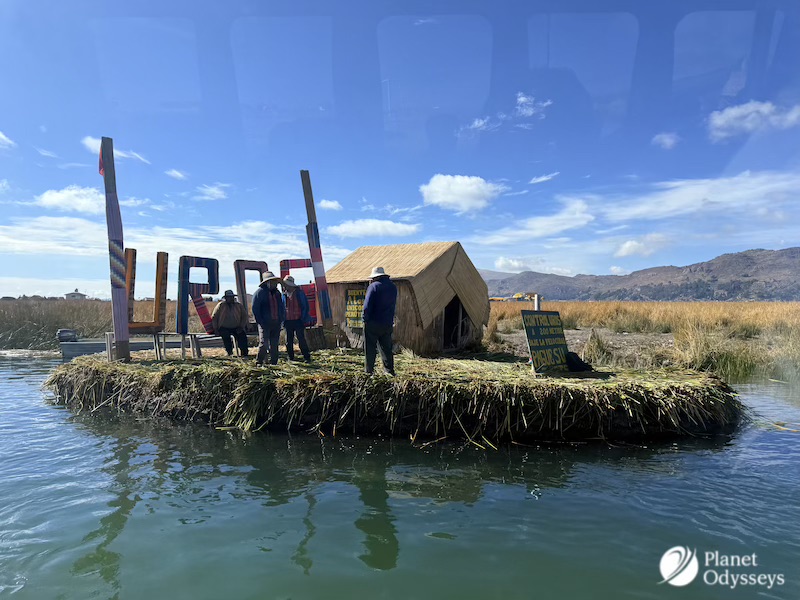
Why it never stops
Here is the part that makes the Uros islands genuinely unusual rather than just picturesque.
The reeds rot from underneath. Water reaches the bottom layer constantly, and that layer is decomposing from the day it goes down. The only response is to keep adding new reed on top, faster than the base disappears.
In the wet season a family may lay fresh totora every two weeks. In the dry season less often, but it never stops entirely.
So the island you walk on is not an old thing that has survived. It is a thing that is continuously being replaced from above while it dissolves from below. The surface is weeks old. The base beneath it is rotting. Neither state is a problem, because the whole design assumes it.
An island built and maintained this way lasts a few decades before a family abandons it and starts again.
Reed does more than the ground, too. Totora goes into the houses, into the boats, and the pale base of the stem is eaten.

Why they went onto the water
The usual account is that the Uros moved onto the lake to get away from stronger neighbours on the shore, whether the Colla or later the expanding Inca. An island can be moved. Land cannot.
How much of that is history and how much is later explanation is genuinely unclear, and anyone who tells you otherwise is more confident than the evidence.
What is not in doubt is that the Uros are old, that they were on the water long before Peru existed as a country, and that most people on the islands today speak Aymara. The original Uru language has all but disappeared.
The honest question: is it a tourist trap?
You will read both verdicts online, usually stated with total confidence. The truthful answer is less satisfying and more useful.
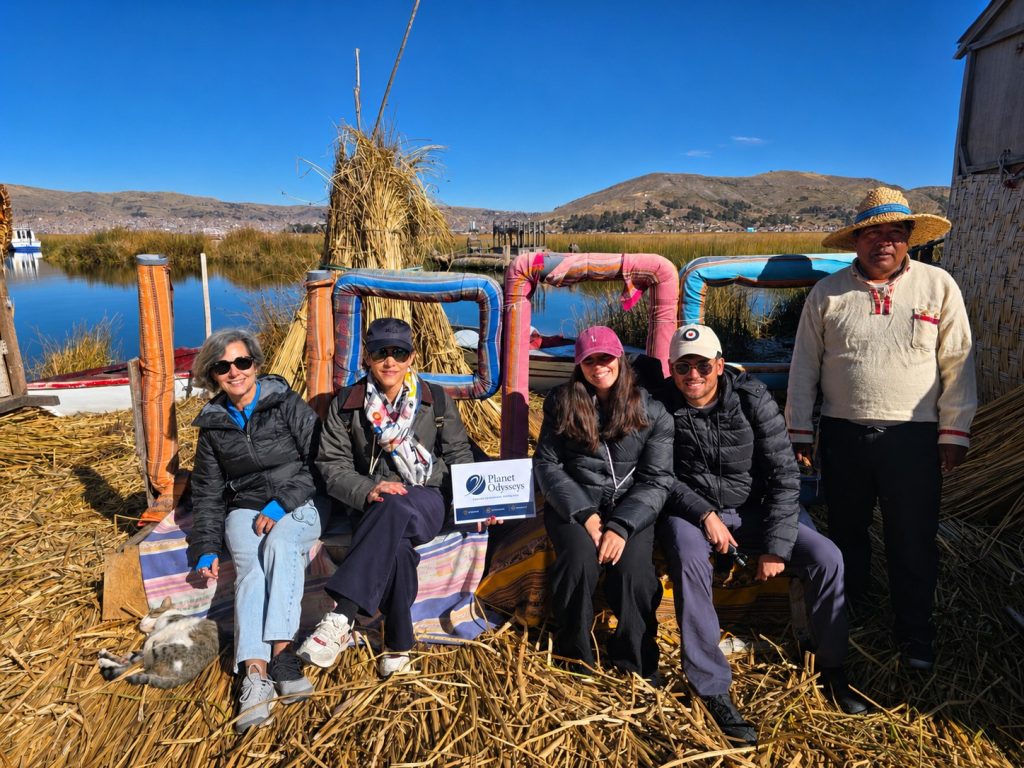
Yes, it is commercial. Boats arrive from Puno every morning. The demonstration of how an island is built is given several times a day, to groups, in a set format. Handicrafts are for sale afterwards, and there is an expectation you will look. Some families have moved to the mainland and commute out. Tourism is now the main income for many of the islands nearest Puno.
And yes, people live there. Children are raised on the islands. The reed is cut and laid because the island would sink otherwise, not because visitors are watching. The building method is not a reenactment of something abandoned. It is maintenance, and it happens whether a boat is coming or not.
Both things are true at once, and that is normal. A working community that also earns from visitors is not a fake community. It is most of rural Peru.
What we would say is this. Go with your expectations set correctly. You are not discovering an untouched people. You are visiting a place where an unusual way of living has survived and now partly funds itself by explaining that way of living to outsiders. Judged as a discovery it disappoints. Judged as what it is, it is remarkable.
Ask questions. The families are used to a script because most visitors want the script. Step off it and you get better answers.

The altitude nobody warns you about
This catches people out badly, and it is the one practical thing we want you to read.
Puno sits at around 3,810 metres. Cusco sits at 3,400.
Going from Cusco to Lake Titicaca means going up, by roughly four hundred metres. Almost everyone assumes the opposite, because Cusco is where altitude gets talked about and Titicaca sounds like a lake rather than a highland.
Plan for it. Arrive having already acclimatised in Cusco, drink more than you want to, and go easy on the first evening. If Cusco was hard work for you, Titicaca will not be easier.
Taquile, the other island
Most trips to the Uros continue to Taquile, and it is a different kind of place entirely. Solid ground, terraces, no reeds.
Taquile is known for textiles, and the knowledge behind them carries a UNESCO listing of its own, inscribed in 2005. The detail visitors remember is who does what. On Taquile the men knit and the women weave, which is the reverse of the assumption most people arrive with.
Clothing carries information. A man’s hat tells you whether he is married. Belts and waistbands record patterns that belong to particular families and particular meanings.
The walk up from the harbour is steep enough to be felt at this altitude. Take it slowly, and the trout at the top is worth the climb.

Bigger islands, solar panels and the lake itself
The islands are not all one size. The largest carry several families together, with a shared meeting space and a school, and the work of keeping the reed floor sound is done together rather than household by household. Those are usually the islands a tour stops at, because they are set up to receive visitors. The smaller family islands are quieter and far less arranged, which is one reason our Uros and Sillustani day from Puno stops at two different communities rather than one.
Life on the reeds is not frozen in time, either. Many households run their lights off small solar panels, and some islands have a system for treating waste so it does not go straight into the water. That matters, because the bay around Puno carries pollution from the town, and the islanders depend on the lake staying healthy more than anyone.
If you want to go
The lake is about 390 kilometres from Cusco by road, which is why our trip uses an overnight bus. It gets you there having slept, rather than losing a day to the road.
Our Lake Titicaca glamping tour covers the Uros and Taquile across three days, with a night in a transparent dome on the shore between them. Sleeping on the lake rather than in a Puno hotel is the part people talk about afterwards. Already in Puno? The Uros floating islands tour takes a morning, and the full-day tour adds Taquile.

The short version
The Uros build islands from totora reed laid over floating root blocks, anchored to the lake bed, and they add new reed continuously because the bottom is always rotting.
The islands nearest Puno are commercial, and people genuinely live on them. Both are true.
Puno is higher than Cusco by about four hundred metres, which almost nobody expects.
Taquile has UNESCO listed textile knowledge, the men knit, and the trout is worth the climb.
For how visits are arranged and which tour to pick, see our guide to choosing a Uros floating islands tour from Puno.