

Qeswachaka hangs across the Apurimac river in Quehue district, Canas province, about four hours south of Cusco. It is roughly thirty metres long. Grass makes up every part of it.
Qeswachaka is the last Inca rope bridge that its communities have never stopped rebuilding. Every June they cut the old one down and throw it in the river.
That second sentence is the one worth sitting with.
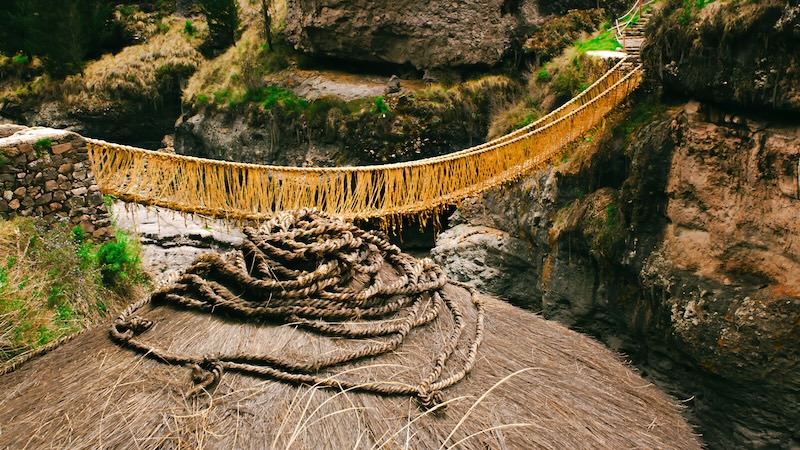
How grass holds a person
Q’oya is a tough highland grass and the only material in this bridge. Pick one blade and it snaps between your fingers.
Rope works because it removes the question of any one fibre’s strength.
Twist a bundle of grass together and the twist presses the fibres against each other. Friction along those contact surfaces means load transfers from fibre to fibre rather than depending on any single strand running the whole length. A short weak fibre becomes part of something long and strong. Twist those cords together into thicker ones, and again into cables, and you can carry a person.
That is the whole principle, and it is the same one holding up a modern climbing rope. The material changed. The idea did not.
At Qeswachaka the finished bridge uses four heavy cables to carry the walking floor and two lighter ones as handrails, lashed to stone anchors set into the rock on both banks. There is no metal in it anywhere. Nothing in it came from a factory.
The deep sag you see in photographs is not sloppiness. A rope bridge carries its load in tension along a curve, and a slacker curve puts less strain on the anchors. It also moves more underfoot, which is the trade the design accepts.
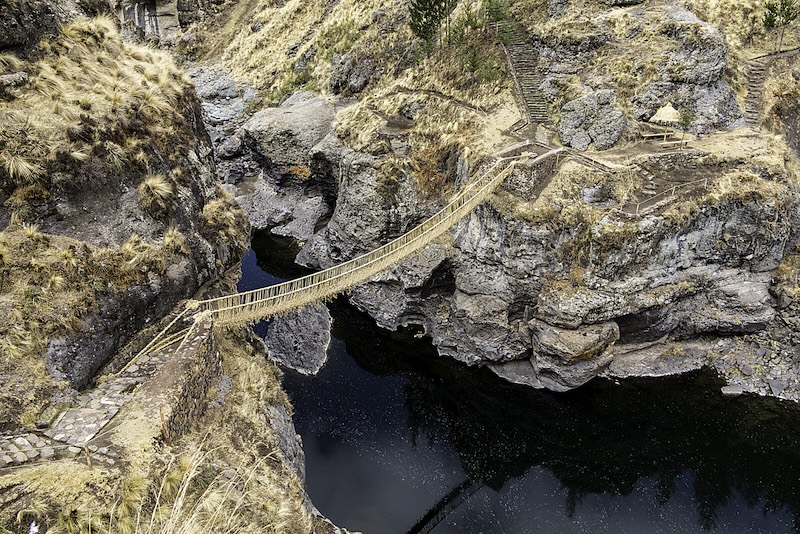
Why the Inca needed bridges this badly
The Inca ran an empire across something like thirty thousand kilometres of road, without wheeled vehicles, without draught animals and without iron.
Everything moved on foot. Soldiers, llama trains carrying goods, and the chasqui runners who passed messages across the empire in relay, faster than a horse could have managed on that terrain.
Gorges cut the Andes. A gorge stops a road. Suspension bridges were the answer, and hundreds of them were built and maintained across the empire, each one the responsibility of the communities living nearest to it.
The Spanish chroniclers who crossed them wrote about the experience with a mixture of admiration and undisguised fear. Some of them dismounted and crawled.
What happens in June
The renewal takes three days of work and a fourth of celebration, in the second week of June.
It does not start at the bridge. In the weeks before, households across the four communities twist q’oya grass into cords called q’eswa at home. Each family brings a required length. That distributed obligation is part of the system, not a detail of it.
They begin by cutting the old bridge loose. It falls into the Apurimac and they keep none of it.
They braid the new cords into progressively thicker cables. Then they haul them across the gorge and tension them by hand. Men handle the heavy cabling out on the ropes. Women work the finer cords. A chakaruwak, the bridge specialist who holds the knowledge of how it all goes together, directs the work.
On the fourth day there is a festival.
Four communities do this: Huinchiri, Chaupibanda, Choccayhua and Collana Quehue.
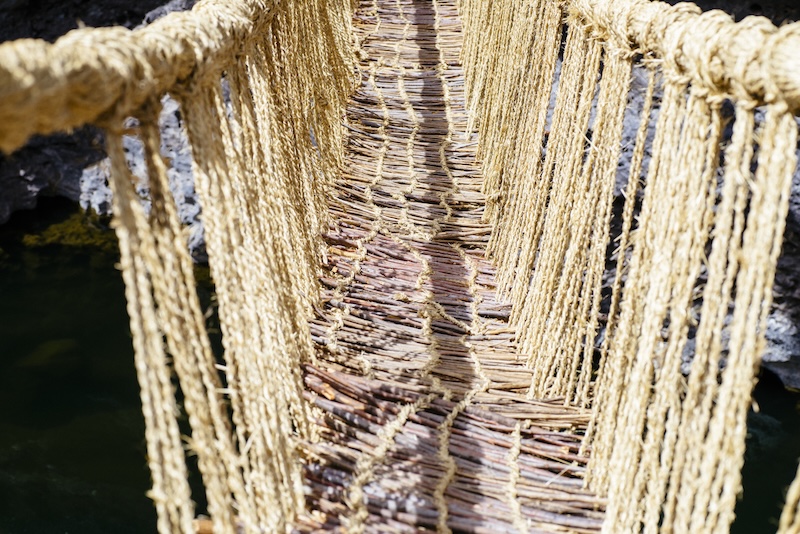
Heritage that is a verb
UNESCO inscribed Qeswachaka on the Representative List of the Intangible Cultural Heritage of Humanity in 2013. Peru had recognised it as national cultural heritage four years earlier.
Read those listings carefully and you notice something unusual. What is protected is not the bridge.
It cannot be. The bridge is at most twelve months old at any given moment, and in June it does not exist at all. There is no original object to conserve, no authentic fabric to protect, nothing that a museum could acquire.
What is listed is the knowledge, the skills and the rituals of the renewal. The heritage is an activity. It survives only for as long as people keep performing it, and it is destroyed the moment they stop, regardless of whether a bridge happens to be hanging there.
This is close to the opposite of how heritage usually works. Machu Picchu is protected by keeping people off it. Qeswachaka is protected by four communities cutting it down and rebuilding it every year, forever.
Which means the bridge is not really the monument. The people are.
Why this is the last one
Hundreds of these bridges once existed. This is the only one whose thread was never cut.
Worth being precise here, because it is a claim people repeat loosely. Grass bridges have been rebuilt in other places as heritage projects. There is one at Checacupe, an hour from Cusco, and the Smithsonian had one built on the National Mall in 2015. Those are reconstructions. They were made by people reviving a practice, not continuing one.
Qeswachaka is different because nobody ever stopped. The obligation passed from one generation to the next without a gap, which is why UNESCO listed the renewal rather than the bridge.
The reason the others went is not that they were poorly built. It is that rope bridges require continuous maintenance by an organised community with a duty to perform it. Break that chain for two years and there is no bridge, only two stone anchors.

You will see the name spelled several ways
Qeswachaka, Q’eswachaka, Queswachaka, Queshuachaca, Keshwa Chaca.
The Quechua parts are q’eswa, meaning braided rope, and chaka, meaning bridge. Braided rope bridge. Quechua has been written down using several competing orthographies and none of them fully won, so spellings vary between maps, papers and tour listings.
All the same bridge.
If you want to see it
The bridge stands for eleven months of the year, and you can walk across it. You go one at a time. It moves underfoot, which is unnerving once and then quite quickly is not.
In the second week of June you can watch it being rebuilt, but there may be nothing to walk on. That choice is genuinely two sided, and we have set it out properly on the Qeswachaka tour page rather than pretending one answer suits everyone.
Visitors watch the renewal. They do not take part in it. This is community work with assigned roles, and it is worth knowing in advance if you have seen it advertised otherwise.
If you would like a look at the idea without the four hour drive, our Pallay Punchu trip stops at Checacupe, where a rebuilt Inca rope bridge crosses the river beside a colonial stone arch and a modern road bridge. Five hundred years of engineering in one view. Qeswachaka is the real one, still made by the people who own it.
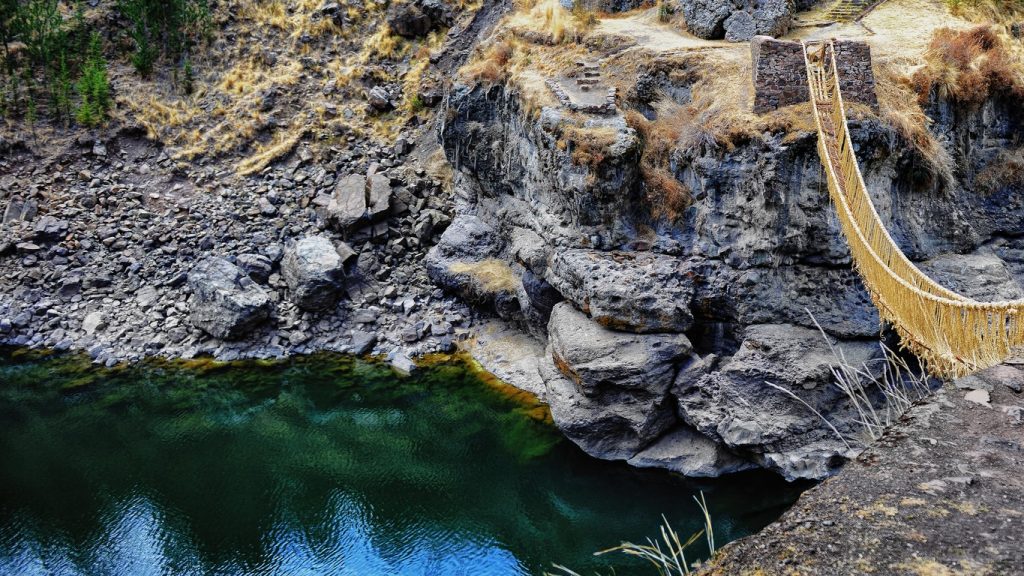
The short version
Qeswachaka is the last Inca rope bridge whose communities never stopped rebuilding it. Thirty metres of braided q’oya grass across the Apurimac, with no metal in it.
It holds because twisting fibres together makes friction do the work, the same principle as any rope ever made.
Four communities cut it down and rebuild it every June. UNESCO protects the knowledge rather than the object, because there is no object old enough to protect.
Every other community let the practice go. These ones never did. Luck did not keep this bridge alive. People did. It is that these particular people never stopped.