
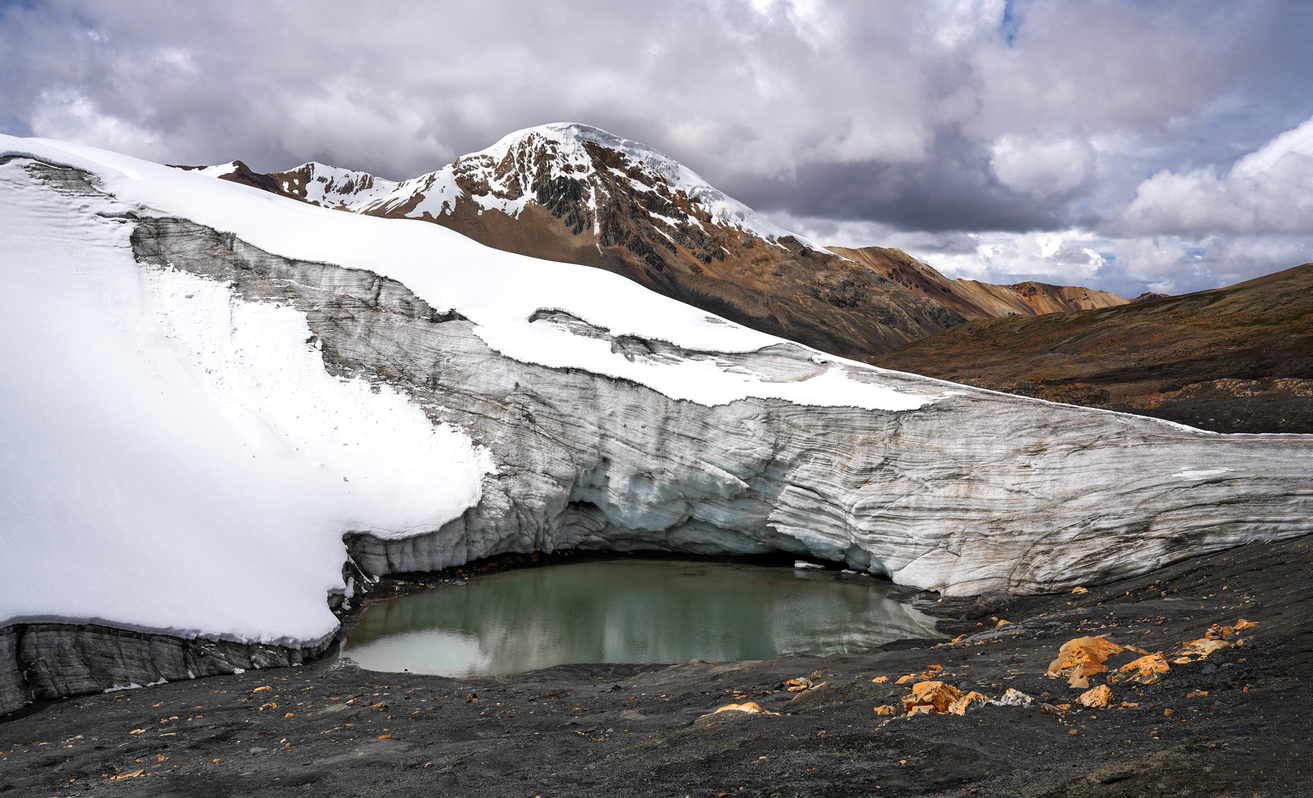
The Quelccaya ice cap sits in the Cordillera Vilcanota, above 5,000 metres, roughly six hours south east of Cusco. It covers around forty square kilometres, which makes it the largest body of ice anywhere in the tropics.
That fact alone gets it into guidebooks. It is not the interesting part.
The interesting part is that Quelccaya is one of the most closely studied pieces of ice on the planet, and what has been read out of it changed how we understand climate in this hemisphere.

What the ice remembers
Ice caps record weather. Snow falls, gets buried, compresses, and each year leaves a layer.
Most tropical glaciers are useless for this, because the layers blur together. Quelccaya is different. The wet season here brings snow and the dry season brings dust off the altiplano, so the layers alternate visibly, light and dark, like tree rings. You can count them.
Lonnie Thompson of Ohio State University began drilling here in the 1970s, and the cores recovered in 1983 were the first from a tropical glacier to yield a detailed, year by year climate record. That record runs back well over a thousand years.
It captured droughts. Quelccaya captured the timing of El Niño. It showed that the tropics were not a passive bystander in global climate but an active part of the machinery. Before Quelccaya, the assumption in the field was that the useful ice records were all polar.
So when you stand in front of this ice, you are standing in front of an archive.
What the 5,000-Year-Old Plants Reveal?
Here is the fact that stops people.
As the margin of Quelccaya has pulled back, it has exposed plant remains that were buried when the ice advanced over them. Those plants have been radiocarbon dated. They are around five thousand years old.
Read that again. The ground now appearing at the edge of this glacier has not seen daylight since roughly three thousand years before the Inca.
Whatever the ice has done in the intervening five millennia, it never retreated this far. It is doing so now, in a single human lifetime.
You do not need a position on climate policy to find that sobering. It is simply what the dating says.

How Quickly Is Quelccaya Retreating?
Qori Kalis is the main outlet glacier flowing off the ice cap, and it has been measured repeatedly since the 1960s. That makes it one of the best documented glacier retreats in the world.
The rate has not been steady. It has accelerated sharply, by something close to an order of magnitude between the earliest surveys and the recent ones. A lake now sits where the glacier tongue used to be. It did not exist when the measuring started.
We are not going to dress this up. Quelccaya is smaller every year we take people there, and the people who study it do not expect that to reverse.
That is a strange thing for a tour company to write. We think saying it plainly is better than the alternative, which is selling a glacier as though it were a permanent fixture.
What Visiting Quelccaya Is Really Like
Ice at this scale does not photograph the way it looks.
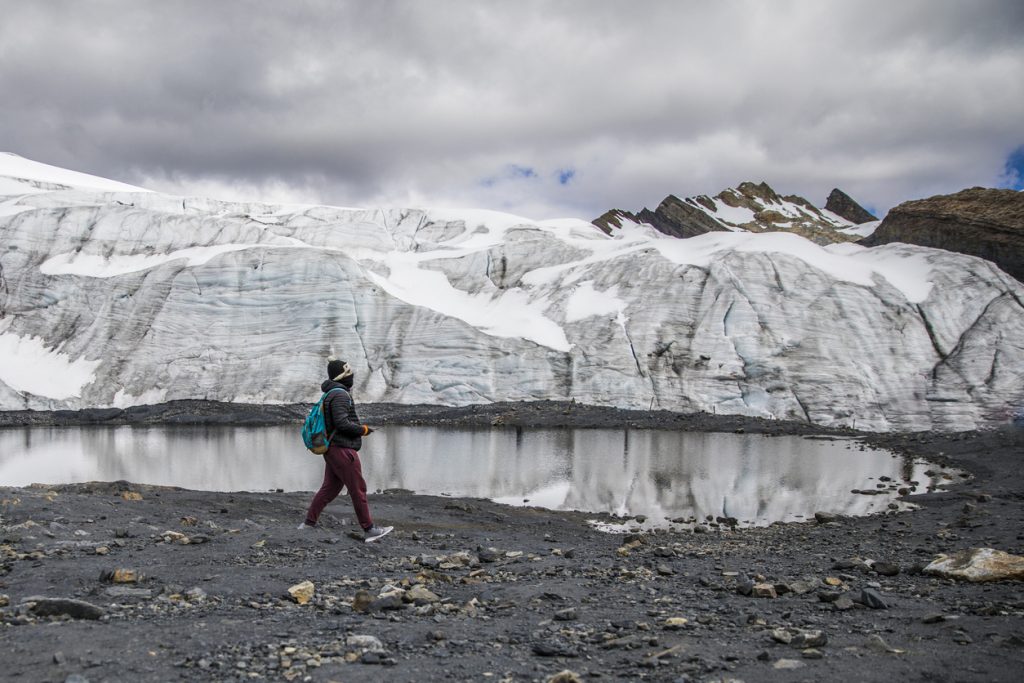
The margin stands in walls rather than sloping away, and the colour in them runs from white through to a blue that has no obvious source. Meltwater runs off the front in threads. On a still day you can hear it.
Around the ice there is nothing. No trees, because nothing grows at this height. No settlement, no signage, no other vehicles most days. Just wet ground, cushion plants, alpaca somewhere in the middle distance, and the ice.
The altitude is felt immediately. Above 5,000 metres nobody moves quickly, and the walking is short precisely because it does not need to be long.

You will see the name spelled several ways
Quelccaya, Quelcaya, Qelqaya, Quelqaya, Qori Kalis for the outlet glacier.
All the same place. Quechua has been written down with several different orthographies over the centuries and none of them fully won, so map makers, scientific papers and tour operators have each settled on something slightly different.
If you are searching for this and getting thin results, try another spelling.
How to Reach Quelccaya from Cusco?
Quelccaya is a long way from anywhere.
Reaching it as a day trip means roughly eleven hours in a vehicle for around ninety minutes at the ice. We publish that ratio on our tour page rather than hiding it, because it is the single thing that decides whether this trip is right for you.
Some people read that and stop. That is a perfectly reasonable response and we would rather they stop before booking than after.
Others read it and understand that this is what it costs to reach the largest tropical ice cap on Earth, and that almost nobody makes the trip. Both reactions are correct. They just belong to different travellers.
Best Time to Visit Quelccaya
May to September. The dry season is not a preference here, it is close to a requirement.
The final approach runs on unpaved ground that turns unreliable in the wet months, cloud sits on the ice cap and takes the view entirely, and there is no shelter anywhere near it. We keep departures limited from November to March and say so.
April and October sit in between. Usually fine, occasionally not.
The short version
Quelccaya is one of the largest tropical ice cap in the world, above 5,000 metres in the Cordillera Vilcanota, around forty square kilometres and shrinking.
Ice cores drilled here produced the first detailed climate record from a tropical glacier and rewrote part of what the field assumed. Plants emerging at its retreating edge are around five thousand years old, which means the ice has not been this small in five millennia.
It takes about eleven hours of driving to spend ninety minutes in front of it, or seven days on foot to arrive properly.
Very few people go. That is worth thinking about while it is still there to visit.