
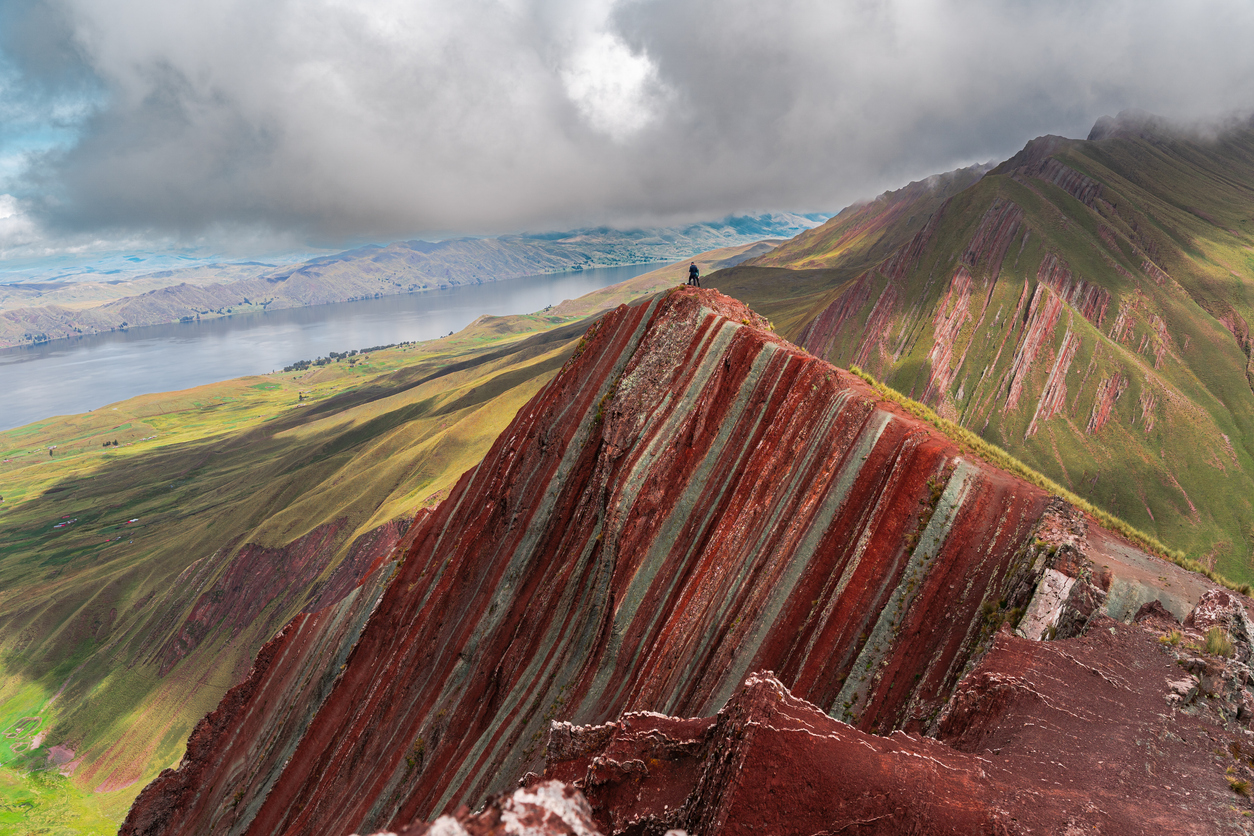
Pallay Punchu stands above the village of Layo, in Canas province, at 4,700 metres. It is a ridge of sharp stone fins, striped in ochre, red, blue and green.
Every article calls it a rainbow mountain. The people who named it did not.
They named it after a poncho.
What the name actually says
Two Quechua words.
Pallay is a weaving term. It means the figured design in a textile, the pattern a weaver raises by picking out particular threads as the cloth is made. It is not decoration applied afterwards. Pallay is structure, chosen thread by thread.
Punchu is a poncho. The Spanish and English word is usually traced back to it, though not everyone agrees on that.
So pallay punchu is a poncho carrying a woven design. The full name of the mountain is Pallay Punchu de Apu T’akllo, which places that patterned cloth on the shoulders of an apu, a sacred mountain.
The name is not describing colour. It is describing cloth, and saying whose it is.
Why the stripes run the wrong way
Here is the part that makes the name precise rather than poetic.
At Vinicunca, the famous rainbow mountain, the colours lie in horizontal bands wrapped around a rounded hill. They read as a layer cake.
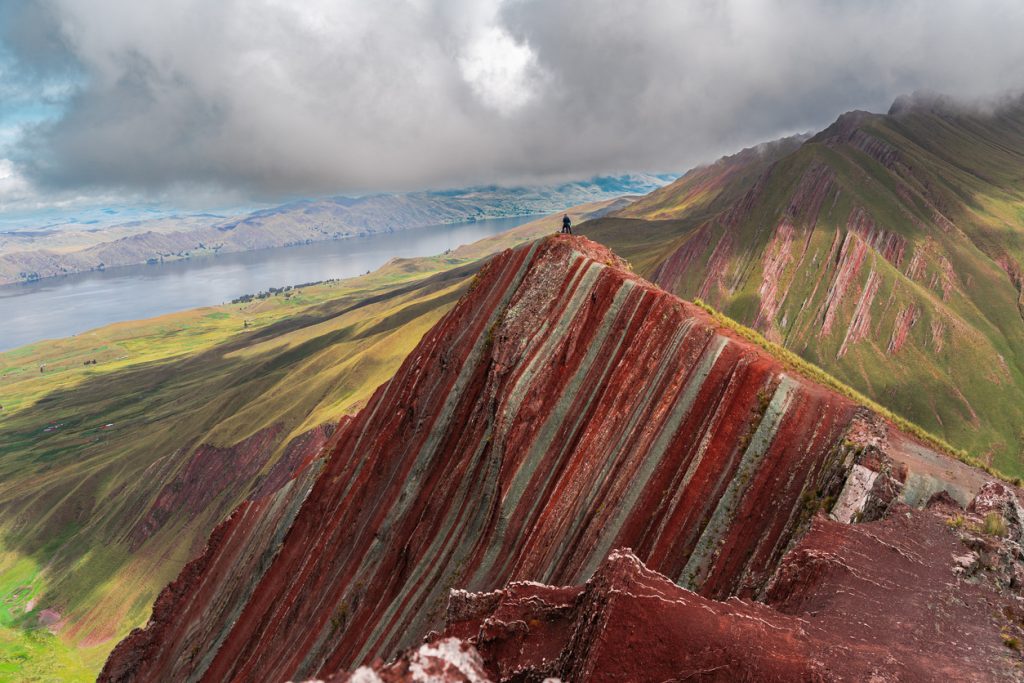
At Pallay Punchu the colour runs vertically, straight up the blades.
The reason is geological. Both are sedimentary rock, laid down in layers, each layer carrying different minerals that give it a different colour. Iron oxides for the reds and rust, other minerals for the greens and pale yellows.
The difference is what happened to those layers afterwards. At Pallay Punchu the beds were tilted steeply, close to upright, then eroded into thin fins. So the stripes stand on end.
Now look at a poncho hanging on a person. The pattern runs down.
Whoever named this mountain was not reaching for a comparison. They were pointing at a thing that hangs in stripes, the way the cloth they make hangs in stripes, and using the word they already had.

Canas still makes them
This is why the name is not a historical curiosity.
Canas province is weaving country, and the ponchos made here are distinctive enough to identify a wearer’s community. The knowledge behind them is not preserved in a museum. It is in use.
So the mountain is named after a living craft by the people who practise it, in the province where they practise it, and you can buy the cloth the mountain is named after within a few kilometres of the trailhead.
That is a different relationship between a place and its name than most tourist mountains have.
Langui Layo, below
The community of Layo sits at 3,978 metres on the shore of Langui Layo, the largest lake in the Cusco region.
From the top of the ridge the altiplano runs flat to the horizon on one side, and the lake lies far below on the other. Most visitors photograph the rock and forget the lake, which is a mistake. The two together are the view.

It appeared on maps about five minutes ago
Pallay Punchu is not a place travellers overlooked for centuries. It became known to visitors only in the last few years.
The people of Layo always knew the ridge was there. It had a name, and that name was already a description of what it looked like. What changed was that photographs of it reached the internet, and a road and a footpath followed.
Which means the visitor numbers are still low. On most days a few dozen people reach the top, against the many hundreds at Vinicunca. That will not last indefinitely.
What visiting involves
The walk from the parking area takes about forty five minutes. It climbs the whole way on uneven ground, but there is no scrambling and nothing exposed.
The high point is 4,700 metres, so the effort is entirely about altitude. Two full days in Cusco before you come, and take the climb slowly.
Entrance is 10 soles, collected at the trailhead, cash only. Horses can usually be hired locally if you would rather ride part of it.
Weather decides the colour here as much as anywhere. Under direct sun the bands are vivid. Under heavy cloud they go flat, and the dry season between May and September is the reliable window.

Compared with Vinicunca
Vinicunca is higher, at 5,036 metres, and takes about ninety minutes on foot rather than forty five. It also draws hundreds of people a day, sometimes over a thousand.
Pallay Punchu is lower, shorter, quieter, and cheaper to enter. It does not give you the photograph people recognise.
We have set both out properly in Is Rainbow Mountain worth it, including the case for going to Vinicunca anyway. If the famous image is what you came to Peru for, nothing here substitutes for it.
If you would rather stand somewhere named by the people who live under it, come here.
Getting to it
Layo is a long way south of Cusco and there is no practical way to reach the ridge on public transport within a day.
Our Pallay Punchu day trip also stops at Raqchi, where the largest roofed building the Inca ever raised survives as a twelve metre adobe wall with more than a hundred stone storehouses behind it, and at Checacupe, where a modern road bridge, a colonial stone arch and a rebuilt Inca rope bridge cross the same river within a few metres of one another.
Three places, one day. The mountain is the reason people book it and rarely the thing they talk about most on the way home.
The short version
Pallay Punchu means a poncho carrying a woven design, in Quechua. The mountain is named after a garment, not a rainbow.
Its stripes run vertically because the rock beds were tilted almost upright before erosion cut them into fins. That is exactly how a poncho hangs, which is the whole point of the name.
It stands at 4,700 metres above Layo in Canas province, takes about forty five minutes to climb, and costs 10 soles to enter.
Canas still weaves the cloth. That is what makes the name worth knowing.