
If you have one day and you are coming from Cusco, see the Peruvian side. You want to walk, and to stand where the Inca said the sun was born, cross to Bolivia. If you have three days, do both. The border down the middle of this lake was drawn in 1825, and the lake has never noticed.
We run trips on both shores. That is the only reason this comparison is worth reading. An operator who sells one side will tell you that side is better. They will be right about half the time.

One lake, two countries, two very different visits
Lake Titicaca covers 8,372 square kilometres at 3,812 metres. Peru holds the western shore and the larger share of the water. Bolivia holds the eastern shore and, more importantly, Isla del Sol.
The two visits barely overlap. From Puno you go out to islands made of reeds and islands famous for weaving. From Copacabana you go out to an island covered in Inca ruins and walk along its spine. Same water, different reasons.
One cliché to clear up first. Titicaca is usually called the highest navigable lake in the world. That is only true if you mean large commercial boats. Plenty of smaller lakes sit higher. It is still the largest lake in South America, which is the more impressive fact and the one nobody uses.

The Peruvian side: Puno, the Uros and Taquile
Puno sits at 3,827 metres, about 400 metres higher than Cusco. It is a working city rather than a pretty one, and the lake is the reason to be there.
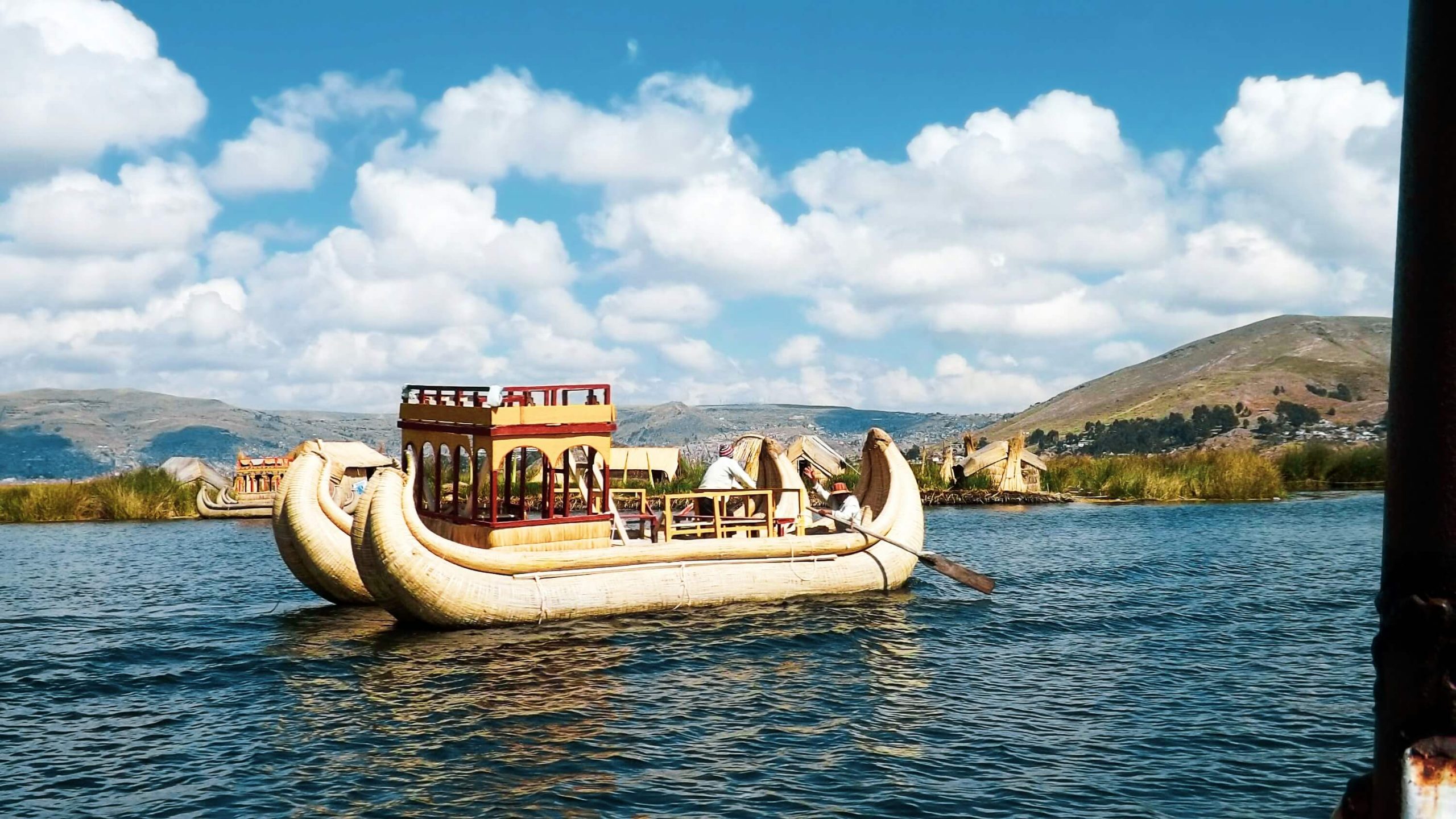
The Uros floating islands are twenty five minutes out by boat. Families live on platforms of totora reed that they rebuild continuously from the top as the base rots from below. It is commercial, with demonstrations several times a morning and handicrafts for sale afterwards. It is also real, in that the reed goes down whether a boat is coming or not. Both things are true and neither cancels the other.
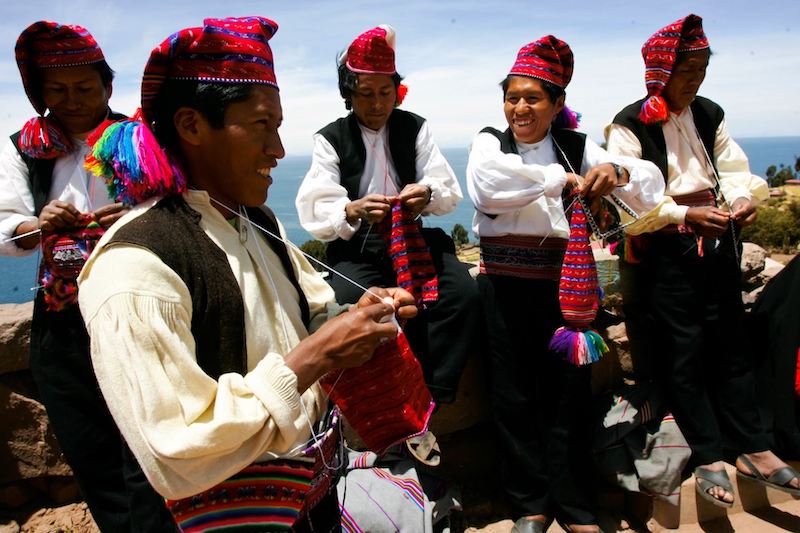
Taquile is a further two and a half hours across open water. UNESCO recognised its textiles in 2005. The detail visitors remember is that the men knit and the women weave. The village sits at about 3,950 metres, up a stepped path that takes forty minutes at a sensible pace. Taquile runs its own tourism collectively, and it shows in how orderly the day is.
Amantani, further out again, is where homestays happen. Families host visitors overnight and there is a climb to one of two hilltop temples for sunset.
What the Peruvian side does best is culture you can watch happening. Reed being laid, cloth being woven, a community running its own island. Nothing on the Bolivian side matches that.

The Bolivian side: Copacabana and Isla del Sol
Copacabana sits at 3,841 metres on a bay with a colonial basilica at its centre. It is quieter than Puno, prettier, and much smaller.
Isla del Sol is ninety minutes out by boat. In Inca belief the sun itself was born here, from a rock on the northern end called the Titikala. Manco Cápac and Mama Ocllo, the founding couple of the Inca dynasty, are said to have emerged from the same rock. From there they walked to Cusco. For an Inca the island was not a place to visit. It was the beginning of everything.
The ruins reflect that. Pilko Kaina in the south is one of the best preserved Inca structures anywhere on the lake. The Chincana, a stone labyrinth, and the Titikala sit at the northern end. The Escalera del Inca climbs from the southern jetty past the Fuente del Inca. Those three springs have run since before the Inca arrived.
The walk between them, along the island’s ridge, is 10 to 12 kilometres and takes three to five hours. Across the water the whole Cordillera Real stands up in a line of snow peaks. There is nothing like it on the Peruvian shore.
Isla de la Luna sits nearby and holds Iñak Uyu, the temple of the chosen women. Fewer boats go, and it is better for that.
What the Bolivian side does best is the Inca, and the walking, and the view.
The comparison, row by row
The last column names the side that wins the row. Draws are marked as draws. Green marks the winning side.
Bolivia takes five rows, Peru four, one draw. Read that carefully, because it does not mean go to Bolivia.
Bolivia takes five rows, Peru four, one draw. Read that carefully, because it does not mean go to Bolivia.
The four rows Peru wins are the four most people came for. The reed islands, the weaving, the homestay, and the fact that it is simply easier. Bolivia wins on the Inca, the walk, the town and the price. Those are different trips for different travellers, which is the honest conclusion and the unhelpful one.

The thing Copacabana has that nowhere else does
On weekend mornings outside the basilica, people bring their cars to be blessed.
Vehicles arrive covered in flower garlands, ribbons, hats and rosaries the size of a person. A priest sprinkles holy water over the bonnet and the engine. He walks around the car blessing each side, then blesses the family. Yellow petals and confetti go over the roof. The family opens a bottle of beer or fizzy wine, sprays some on the wheels and drinks the rest. Then a string of firecrackers goes off underneath.
The Virgin of Copacabana is the protector of travellers, which is why. Francisco Tito Yupanqui, a descendant of Inca nobility, carved her statue in the 1580s. Pilgrims have arrived ever since.
One more detail people enjoy. The beach in Rio de Janeiro is named after this town. A chapel to the Virgin of Copacabana stood on that Brazilian shore and the neighbourhood took her name. The Bolivian one came first.
The one thing to check before choosing Bolivia
The north end of Isla del Sol has closed to visitors more than once in recent years.
The island’s northern and southern communities have a long running dispute over tourism income. The north has shut intermittently since 2017. When it is closed you can still land in the south and walk part of the ridge. The Titikala and the Chincana are off limits.
We check which sections are open the day before we travel and tell clients before the boat leaves, not after. Do not trust a guide to the island written more than a few months ago.
So which side?
If you have one day and you are coming from Cusco, the Peruvian side. It is a straightforward day and it has the reed islands, which have no equivalent anywhere.
If Bolivia wins, the road usually carries on south. Our one day Bolivia salt flats tour from Uyuni is the reason most people cross in the first place.
If you have two days and you want to walk, Bolivia. The ridge walk on Isla del Sol with the Cordillera Real across the water is the best half day on the whole lake.
If you have three days or more, both. Our three day journey from Cusco takes in the Uros and Taquile, with a night in a dome on the shore. Our longer routes continue over the border to Copacabana and on to La Paz. The lake is one place. Seeing one side and calling it done is like visiting a house and staying in the hall.
Our three day Lake Titicaca journey from Cusco covers the Peruvian side. For the crossing itself, our guide to the Kasani border covers what happens and what to check before you walk away from the window.

Frequently asked questions
Which side of Lake Titicaca is better, Peru or Bolivia?
Neither, for different reasons. Peru has the Uros floating islands, Taquile weaving and easier access from Cusco. Bolivia has Isla del Sol, the Inca origin site, better walking and a quieter, prettier town. Travellers with three days should see both.
Can you visit Lake Titicaca from Cusco in one day?
Not usefully. Puno is 484 kilometres from Cusco. A one day visit means a night in Puno and a full day on the water, which is why our shortest lake trip runs three days.
Is Isla del Sol worth visiting?
Yes, if the walking appeals. The ridge walk is 10 to 12 kilometres with views of the Cordillera Real, and Pilko Kaina is one of the best preserved Inca sites on the lake. Check that the north end is open before you go, because it closes intermittently.
Is Copacabana in Bolivia the original Copacabana?
Yes. The beach in Rio de Janeiro took its name from a chapel dedicated to the Virgin of Copacabana, whose shrine is this town’s basilica.
How high is Lake Titicaca?
The surface sits at 3,812 metres. Puno is at 3,827 metres and Copacabana at 3,841 metres, so the two shores are almost identical for altitude.
Do you need to cross the border to see both sides?
Yes. Peru and Bolivia meet on the lake’s southern shore at the Kasani crossing near Copacabana. It takes thirty to sixty minutes on foot between two migration offices, and Bolivia is one hour ahead of Peru.