

Yes, if you have acclimatised properly and you accept the crowd.
No, if you landed in Cusco this week, or if sharing a summit with several hundred people would ruin it for you.
That is the whole answer. Everything below is how to work out which of those two you are, before you have paid for it.

What Vinicunca actually is
A ridge in the Cusipata and Pitumarca districts of the Cusco region, on the western edge of the Ausangate massif, with a high point of 5,036 metres.
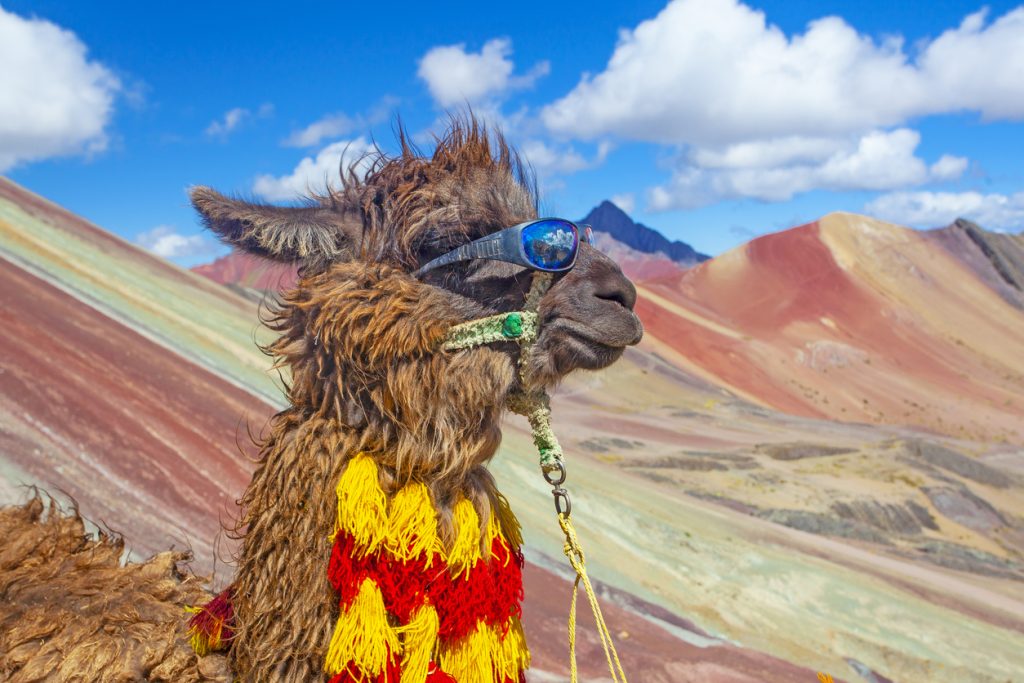
The stripes are real and they are not enhanced in the photographs you have seen, though they are usually taken in the best possible light. Sedimentary layers laid down over millions of years, each carrying different minerals, then tilted and worn back until the layers show as bands on the surface. Iron oxides give the reds and rust. Other minerals give the greens and the pale yellows.
The Quechua name is Vinicunca or Winikunka. In Spanish it is the Montaña de Siete Colores, the mountain of seven colours.
The fact almost nobody mentions
Vinicunca was not a destination ten years ago. It was not hidden, undiscovered, or secret. It was under snow and ice.
The mountain became visible, and then famous, as the ice retreated off it during the last decade or so. The first tour groups arrived around 2015. What you are queuing to photograph is essentially a consequence of a warming Andes.
That does not make it less beautiful. It does change what you are looking at. The same process is measured a few hours away at Quelccaya, where plants emerging from under the retreating ice have been dated at around five thousand years old.
Worth carrying that up the hill with you.
The altitude is the real problem, not the walk
Vinicunca tops out at 5,036 metres.
For scale, that is higher than Mont Blanc, the highest mountain in western Europe, and higher than any peak in the continental United States. People book it as a day trip, from a city, in trainers.
The walking itself is not hard. Roughly ninety minutes each way on a graded path, with horses available for most of it if you want one. The last section to the viewpoint is the steepest part and the part where people stop.
The difficulty is entirely oxygen. At 5,036 metres the air holds around half what it does at sea level. That is the number to think about, not the distance.
Two full days in Cusco minimum, and three is better. The single most common reason people describe Rainbow Mountain as miserable is that they booked it for day two of their trip.
The crowds, honestly
In high season, expect hundreds of people. On the busiest days it runs well past a thousand.
Buses leave Cusco between three and four in the morning, and most of them arrive at the trailhead within the same hour. The result is a queue on the path and a scrum at the viewpoint, where people wait their turn for the photograph on the small crest at the top.
If you go, go in the very first vehicles and walk without stopping. Half an hour makes a visible difference to what the ridge looks like.
None of this is a scandal. It is what happens when a place becomes famous quickly and there is one path to it.

The colour needs sun
This decides more trips than the crowd does.
The bands read as colour under direct light. Under heavy cloud they flatten to grey and brown, and the photographs you have seen become impossible. Rain or snow on the ridge does the same.
May to September is the reliable window. In the wet months you can drive four hours, walk ninety minutes, and see a grey hill. That happens, and no operator can prevent it.
So who should actually go
Go if you want the picture, you have given yourself two or three days in Cusco first, you are content with a well made path rather than wild country, and you understand the crowd is part of the deal.
Do not go if your dates are in the wet season and you cannot move them, you have a heart or lung condition, you arrived in Cusco within the last two days, or the thing you want from a mountain is quiet.
That last one matters more than people admit. Some travellers want the famous view. Others want to feel like they have gone somewhere. Vinicunca reliably delivers the first and rarely the second.
If quiet is what you want instead
Two alternatives, and we run both, so read that with the appropriate scepticism.
Pallay Punchu is a ridge of striped rock fins at 4,700 metres above Layo, reached in about forty five minutes on foot. Fewer people by an order of magnitude. The same day also takes in Raqchi, where a twelve metre Inca temple wall still stands with a hundred stone storehouses behind it, and Checacupe, where three bridges from three centuries cross the same river. Three places rather than one.
Ausangate 7 Lakes goes to the mountain that Vinicunca sits on the edge of. Seven glacial lagoons, three to three and a half hours of walking, then thermal pools at 4,300 metres with the glacier in front of you. It is considerably harder than Rainbow Mountain and it is the better day if you have the legs for it.
Neither gives you the photograph people recognise. That is the trade, and it is a real one. If the image is what you came for, no alternative substitutes for it, and you should go to Vinicunca.

The verdict
Rainbow Mountain is worth it if you arrive acclimatised, in the dry season, early, and knowing there will be a crowd.
It is not worth it if you are treating it as a warm up on your second day in Peru. That is the version people write bad reviews about, and the mountain is not what went wrong.
Decide honestly which describes you. Then book accordingly, with us or with anyone.